.avif)
Business users are trained to question data. They sanity-check results, compare numbers to expectations, and are usually the first to notice when something doesn’t look right.This happens at the point of decision, when dashboards, metrics, and ad-hoc analysis are being used to decide what to do next.
In many teams, reliability work is already happening. The problem is not the absence of checks, but where the results live. Engineers define tests, set up monitoring, and investigate failures. Data health, failures, and incidents usually live in tools designed for engineers, disconnected from where decisions are made. When something looks off, business users cannot tell whether it is a known issue, a new failure, or an expected change.
As a result, engineers become the default escalation path. Business users either wait for confirmation or repeat validation work that has already been done.
Reliability breaks down not because of a lack of effort, but because visibility and collaboration stop short of the business user.
Fixing this requires a shared source of truth that both engineers and business users can rely on.
How this works in practice
First, the approach: a single source of truth for data reliability, accessed without turning analysts into engineers.
Elementary maintains one shared view of the data stack. What data exists, how it is built, what depends on it, and what is currently happening to it. Engineers and business users rely on the same context, even though they interact with it differently.
This shared context is what makes reliable, self-serve workflows possible.
Find and understand the right data
Business users need to find the right data for the task at hand, understand how it’s calculated, and what it’s based on.
Elementary enables plain-language discovery across tables, metrics, and data products. Users do not need to know names or schemas. Once they find an asset, they can see how it is built, where it comes from, and how it is used downstream.
Lineage, transformations, and semantic definitions are visible end-to-end, so analysts can understand a number before they trust it.
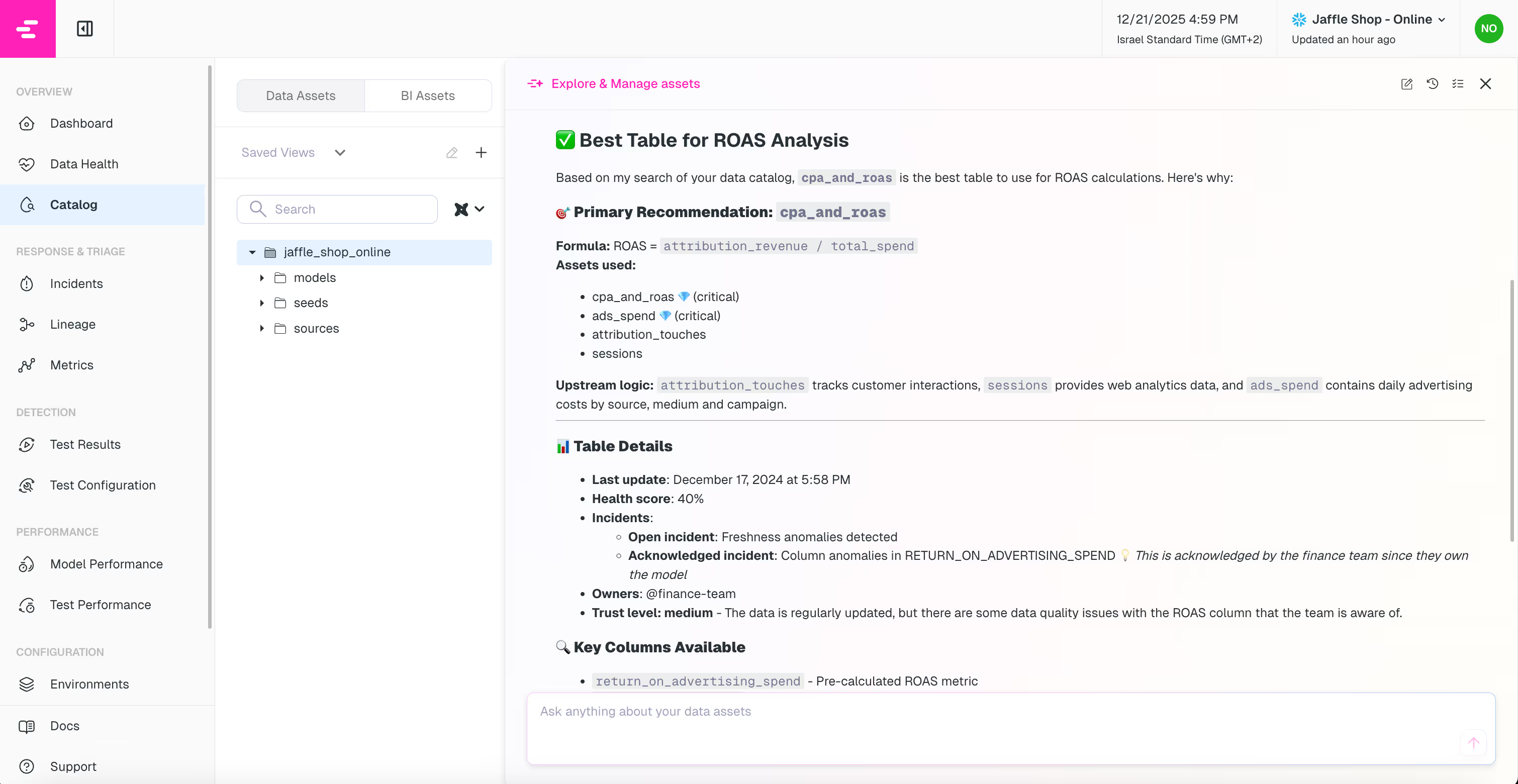
An analyst can ask: “What’s the best table to use for ROAS?” and find the right table, understand how the metric is calculated and the table’s current health status.
Trust the data at the moment of use
Trust should be visible, not inferred.
Elementary shows the current health of data products in one place. Assets are clearly marked as healthy, degraded, or impacted, with incidents and failing checks attached.
Because Elementary understands upstream and downstream relationships, impact is contextual. Analysts can see whether an issue affects the data they are using before they act.
.avif)
Validate business expectations safely
Even when pipelines are green, business expectations still matter.
Elementary allows business users to add their own data quality checks in plain language or SQL. These checks run continuously alongside engineering guardrails and are fully visible across teams.
Business users can validate assumptions independently, without breaking standards or waiting on engineering.
.avif)
Proactive, business-friendly alerts
Elementary delivers simple, impact-oriented alerts that explain the issue in plain language and show the affected assets and relevant ownership. The subscribed business users are notified as soon as an upstream issue puts a critical data product at risk.
Alerts are shared across teams at the same time, so everyone works from the same current understanding of what is happening. This supports smoother collaboration between engineering and business teams.
.avif)
Bring Elementary into business user workflows
Reliability context should meet users where they work, not the other way around.
Elementary brings data health, incidents, and context directly into the tools business users already work in. This includes AI workflows such as internal analytics agents, external catalogs like Atlan and Collibra, and soon, connected BI tools.
Business users can understand whether the data is safe to use, ask questions, explore issues, and understand impact in place, without switching tools or losing context.
Users can connect the company’s analytics agent and make sure the marketing spend data is safe for reports:
.avif)
Governance that holds at scale
For governance teams, maintaining policies at scale is hard. As new assets are created and existing ones change, documentation and classification quickly fall out of date.
In Elementary, governance policies are defined as rules. Agents use those rules and existing data context to apply tags, descriptions, and classifications across assets at scale.
Enforcement happens in the CI process, so assets that do not meet policy requirements are flagged before they reach production. Governance stays part of everyday workflows instead of a cleanup task.
.avif)
Engineers prevent breaking changes to data products
Reliability is not only about reacting to issues. It is also about preventing them.
Elementary maintains lineage from ingestion all the way to BI, so engineers can understand the impact of a change on business-critical assets before deployment. They can see how a pipeline change propagates through upstream tables into dashboards and metrics, and whether it will cause breakage.
This makes collaboration with business users straightforward and timely, rather than reactive after issues surface.
What changes with the right workflow
Using data no longer requires extra checks or escalations. Decisions can move forward faster, and with clarity instead of hesitation.
When business users can find and understand data, see its health, validate expectations, and work from shared context, reliability becomes part of everyday work.


