
We’ve been building Elementary into a centralized reliability layer across the data stack: one place for data teams to manage data quality, and one source of truth for people and AI agents to know what they can trust.
Today, we’re introducing Elementary Runtime, now in private beta, to extend what that layer can do.
Runtime lets supported data-quality queries and AI agent tasks run inside the customer environment, while Elementary Cloud manages the workflow. This gives Elementary a secure way to validate data, investigate issues, improve monitoring based on real usage, and power AI workflows directly against the data without extracting it from the customer environment.
Building on one place to manage and understand data quality
To understand what Runtime adds, it helps to start with what Elementary already brings together today.
Elementary connects directly to one or more data warehouses, combines that coverage with in-pipeline tests for dbt and Python, and adds Cloud Tests that run independently of the pipeline.
These signals don’t live in isolation. Elementary builds warehouse and column-level lineage across the data, combines it with pipeline context, and groups related failures into the same incident. Instead of a collection of alerts and tests, teams get a connected view of what is happening, what is affected, and where to investigate.
Elementary already understands the data, its dependencies, monitoring coverage, and the issues affecting it. Runtime adds a secure way to work with the underlying data itself when understanding the context is not enough.
What Runtime unlocks
Monitor closer to the business
Some of the most important data-quality expectations live outside the pipeline.
An AI agent working with a semantic metric may identify that it isn’t sufficiently monitored and add a check for it. Other business-critical metrics or datasets may need validation on their own schedule, independently of the pipelines that produce them.
Cloud Tests already let teams define these checks independently, including custom SQL, data contracts, no-code checks, and tests created with AI. Runtime gives Elementary a secure way to execute the underlying work inside the customer environment.
Investigate failures with the data itself
Tests, anomalies, lineage, and logs can tell an investigation agent a lot. But sometimes the next useful step is a query.
Did the issue affect every customer or only one segment? Did values disappear at a particular point? Does the underlying data support the hypothesis suggested by the anomaly?
Runtime lets supported investigation tasks execute inside the customer environment. Generic agents can use the context Elementary already has, validate a hypothesis, and continue the investigation with the result rather than stopping at the signals around the problem.
Give consumers context without giving them warehouse access
The people and systems using data often need to understand its state without needing direct access to the warehouse.
A business user, application, or AI agent may need to know whether a metric is healthy, whether an upstream issue affects it, or whether a result can be trusted.
Elementary can bring together monitoring, tests, lineage, incidents, and deeper validation to answer those questions. Runtime handles the work that requires access to the underlying data, while the consumer gets the context it actually needs.
Improve coverage based on how data is used
What people and AI agents actually query is another signal for what should be monitored. If an important table, metric, or data product is being used but has weak monitoring coverage, Elementary should be able to identify that gap and improve coverage around it.
Runtime gives Elementary secure access to the inputs and outputs of analytics AI agents inside the customer environment. That makes it possible to build a continuous loop: identify what data the agent is using, check whether it is sufficiently monitored, validate the data when needed, and add the relevant missing monitoring so it stays covered and certified going forward.
Over time, this lets monitoring evolve around the data people and agents actually depend on, rather than relying only on coverage defined in advance.
How Elementary Runtime works
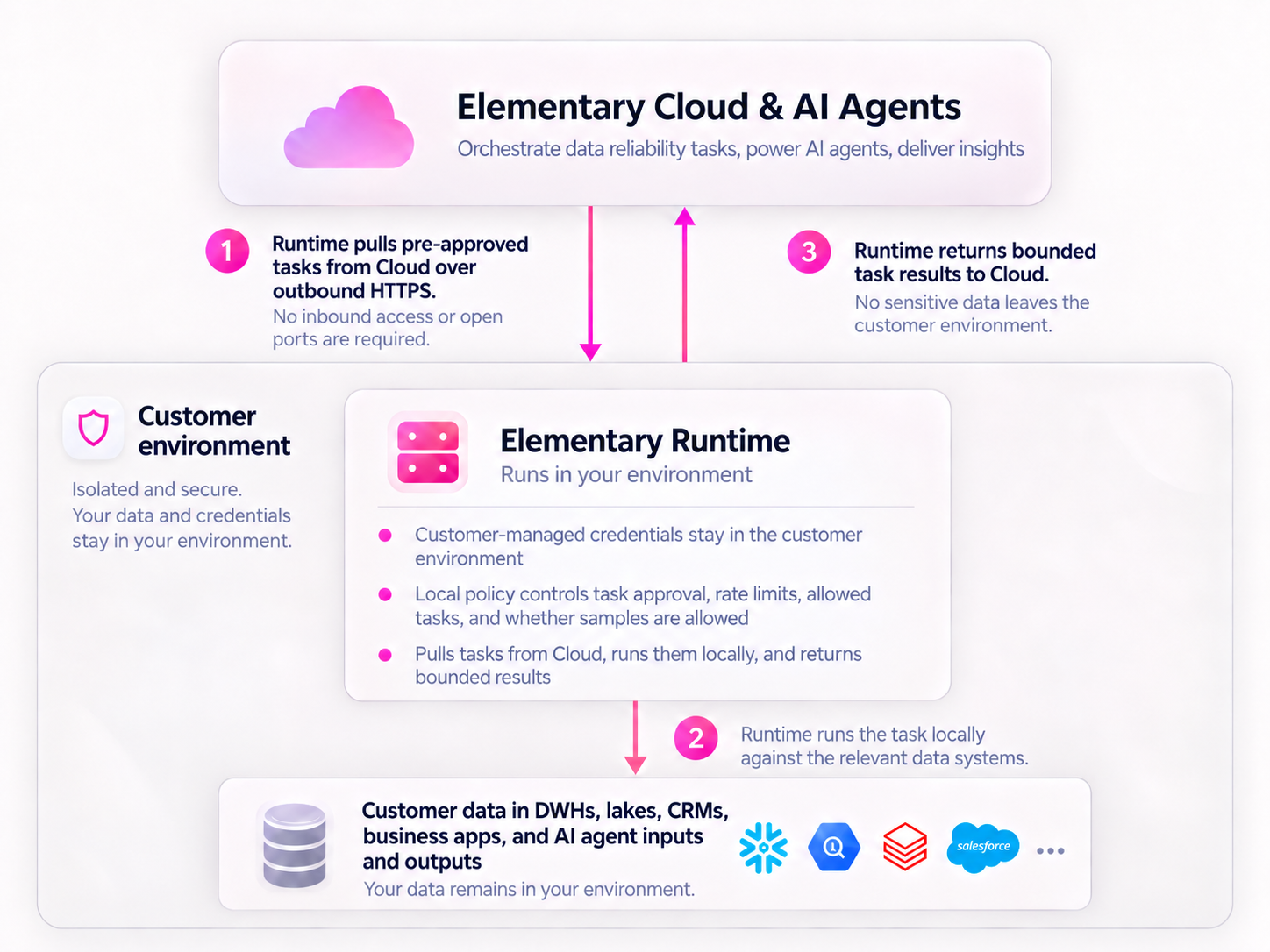
Elementary Runtime is a lightweight service deployed inside the customer environment.
Elementary Cloud manages the workflow, including tests, schedules, incidents, AI workflows, and the tasks that need to run. Runtime pulls pre-approved tasks from Elementary Cloud over outbound HTTPS, so there is no need to expose the customer network to inbound internet traffic or open ports.
Before execution, Runtime validates the task against local policies. Customers control the credentials used to access their systems, which tasks are allowed, execution limits such as rate and concurrency, and whether sensitive outputs such as row samples can be returned.
Runtime runs the approved task against the relevant data system and returns only the bounded result required by the Elementary Cloud workflow. Customer-managed credentials and sensitive data stay inside the customer environment.
One reliability layer for managing and using trusted data
Runtime brings the two sides of the reliability layer closer together. Data teams can manage quality across the stack, while users and AI agents get the context they need to understand what they can trust.
By adding secure execution to the context Elementary already has, Runtime opens the door to deeper monitoring, investigation, and AI workflows, without moving sensitive data out of the customer environment.
Elementary Runtime is now available in private beta. Talk to the team to learn more.


.avif)


