
For years, the consumers of data were people: analysts writing SQL, executives reading dashboards, operators acting on a number in a report. A lot of that consumption is now done by AI agents. Analytics copilots, BI bots, and autonomous agents query the warehouse directly and act on the results, updating forecasts, adjusting budgets, sending messages, and passing numbers to the next agent in a chain.
They're very good at getting an answer. They have no way of knowing whether the answer is any good. A stale number and a correct one look identical, and an agent has no instinct to tell them apart. That gap, not model quality or query skill, is what keeps most teams from letting agents near decisions that matter. In recent MIT Technology Review Insights research, only about half of organizations said they trust the decisions their AI agents make. Trust is the ceiling on adoption, and it isn't being solved only by better models.
The overlooked half: the inputs
"Trust" has become an overloaded word, so it's worth being clear about which problem we mean. Most work on agent trust evaluates the outputs: tracing the agent's steps, checking its reasoning, reviewing what it produced after the fact. That work matters. The same scrutiny rarely reaches the inputs: was the data behind the answer good enough to act on, and did anyone confirm that before the agent replied? That's the question this post is about.
Agents can read data, but they can't judge it
A good analyst does more than write SQL; they know the business. They know a normal week runs about $2M, that a strategic account renewed last month, and that the company only sells in the US. So when revenue comes back at $6M they suspect a double-counted load before a record week; when that account shows zero usage they assume a broken pipeline, not a lost customer; and when sales show up in Europe, they know it's a mapping bug, not a new market. That judgment lives in the analyst's head, not in the data.
An agent has none of it. It takes the query result at face value and reports it, fluent and confident, with no sense of whether the number is even plausible. The damage compounds when the agent acts on it: a marketing-ops agent that sees conversions "collapse" from a half-loaded pipeline can pause your best campaigns for a day before anyone realizes the data was just late.
These silent failures come in different shapes, but they share one trait: the query still returns a clean-looking number, so the agent has no reason to doubt it.
- Stale data. The pipeline stopped updating, but the query still returns rows, so a stale number reads as current.
- Partial loads. The latest period is only fractionally loaded, so the total comes back quietly low while freshness looks fine.
- Silent inflation. A duplicate load or a fan-out join multiplies a total, and it still looks plausible enough to report as a record quarter.
- Broken upstream or schema. A source failed a few hops up, or a column was renamed, and the change flows into an otherwise clean table as a believable, wrong answer.
- Changed business logic. A definition shifts, a new pricing tier, a different rule for an "active user", but the model computing it was never updated, so the table keeps returning the old rule.
- Right in total, wrong up close. The aggregate looks normal, but a churned account shows fresh usage, a clean number that only fails against what you know about the business.
In every case the number looks clean and isn't, and nothing in the result tells the agent that something is off.
The fix isn't smarter agents. It's a shared reliability layer.
The obvious shortcut is to teach each agent to check its own data. It's the wrong move. Checking data properly is expensive in warehouse compute and tokens, and paying that inside every agent is what stops you from opening reliability up to all of them.
Consumer agents already have hard jobs: interpreting a vague question, finding the right tables, writing correct SQL, and composing a clear answer. Reliability is a separate discipline built on monitoring, lineage, coverage, usage, and historical patterns. Loading all of that onto every agent makes each one slower and worse at the job it was built for. Latency kills adoption, because no one waits on an answer. And there's rarely just one agent. A BI copilot, a forecasting agent, a support assistant, and an ops bot often read the same tables. Put reliability inside each of them and you build the same logic several times, keep several copies of the same context in sync, and get several slightly different answers to "can I trust this?" Trust that varies by agent isn't trust.
So define it once, the way you'd stand up one authentication service instead of rebuilding login in every app. A reliability layer owns how to validate, holds the context on how each asset behaves, and answers a single question for any agent that asks: can I trust this data, for this query, right now? The consumer agent's side stays simple, ask and act on the verdict. You get one definition of trustworthy, applied consistently, with one place to govern it and one place to improve it as pipelines change.
There's a practical payoff, too. A shared layer is the only component that sees what every agent consumes, and no single agent has that view. That picture of real usage is what powers the coverage loop we'll get to below.
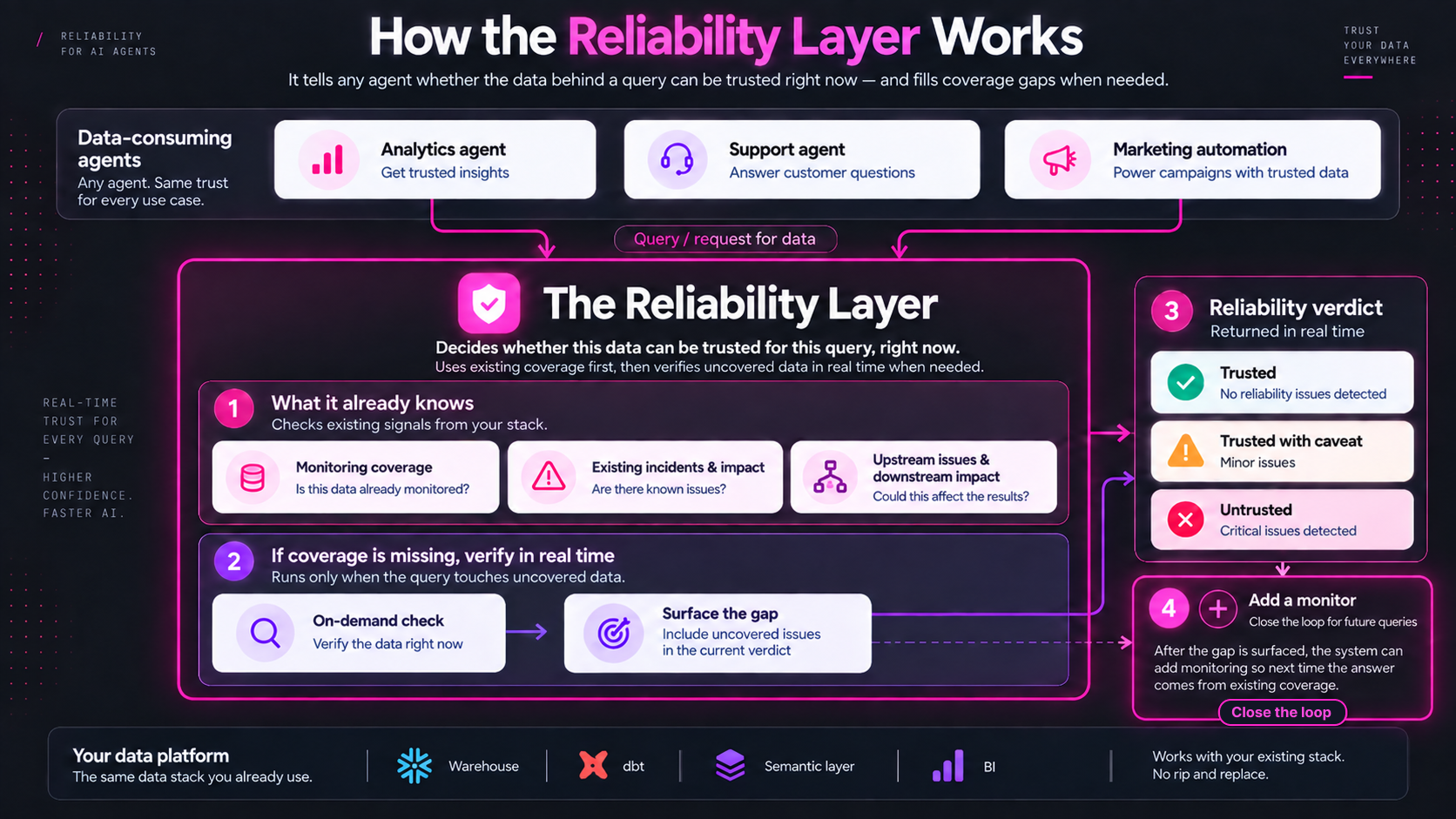
What a reliability layer does
Delegation only helps if the layer is genuinely good at the job, and being good at it means answering the failures above directly:
- Check every dimension. Freshness, completeness, uniqueness, validity, accuracy, and consistency each fail on their own. This is what catches the stale table, the partial load, the duplicate that inflates a total, and the column that drifted.
- Separate "checked and fine" from "never checked." This is the subtle one, and it's where naive approaches quietly fail. When your monitoring doesn't raise a warning, that silence has two very different meanings: either everything was checked and passed, or nothing was ever checked at all. An agent reads both as "all clear," so it will trust a column no one has ever looked at just as readily as one that's fully covered. A reliability layer keeps track of what is actually monitored, so when a query touches data that nothing has verified, it returns "unverified" instead of a false all-clear, and then it goes and checks that data on the spot rather than guess (more on that next).
- Judge against business context, not just statistics. A number can pass every generic check and still be wrong for this customer or this week, while a real jump from a real deal looks like an anomaly. Useful checks encode what the business expects: baselines, known events, and domain rules like refunds never exceeding sales. Much of that already lives in your semantic layer and agent skills. The reliability layer integrates with them both ways: it inherits those definitions instead of making you maintain them twice, and it feeds reliability signals back, so the same context that tells an agent what a metric means also tells it which data it can trust.
- Follow lineage and calculate impact. Surfacing every upstream alert is just noise. The useful part is working out whether an upstream issue actually reaches the columns and window this query reads, and returning the impact rather than the raw alert.
- Scope to the query. Reliability is a property of what the query touches, these columns and this window, not the whole table. Scoping keeps the check fast and the answer relevant.
- Return a verdict, not raw signals. Hand back a decision the agent can act on: trusted, trusted with a caveat ("complete through yesterday, today is still loading"), or blocked with the failing dimension and an owner to route to. "I can't trust this yet" becomes a real, useful answer.
Reliability sits alongside two other pillars of trust: governance, whether the agent is allowed to see the data, and semantics, whether "revenue" means what the business means. Both matter, and both assume the data itself is sound to begin with. That foundation is the part a reliability layer can verify at query time.
Close the loop: monitoring that improves itself
No monitoring setup covers everything, so the layer needs a fallback. When a query touches data that nothing is watching, it verifies that data on the spot instead of guessing. That on-demand check is what keeps every query reliable, even on the parts of the warehouse no one thought to monitor, and it's the only thing that can catch a problem nobody set up a test for.
But on demand can't be the main mechanism, because it doesn't scale. Checking data live on every query means scanning the same tables again and again, adding latency to every answer, and paying more with each agent and each question. It's also reactive: the check only runs once someone asks, so the first agent to hit bad data is still the one that gets the bad answer. On demand is the right safety net; it's the wrong thing to lean on for everything.
The way forward is to treat every on-demand check as a signal, not a one-time save. Each one shows you exactly where your monitoring has a gap. Put that together with what your agents actually consume, the most-queried tables and columns, the metrics the business depends on, and you get an evidence-based, prioritized picture of what you should be monitoring and aren't. Then act on it continuously: turn those recurring gaps into deterministic monitors, so the next time that data is used it's already covered, cheaply and ahead of time.
That loop is the whole point. Coverage stops reflecting what someone guessed would matter when they first set things up and starts following what's genuinely used. The expensive on-demand work shrinks over time to whatever is truly new, while a growing base of cheap, deterministic monitors catches known problems before any agent trips over them. The more your agents use the data, the better your monitoring gets, which is the opposite of static monitoring that quietly decays as pipelines change.
This is an agentic layer, not a passive gateway, but its autonomy has a deliberate boundary: it detects, raises incidents, and routes them to owners, and it proposes the monitors that close each gap, while people still own the fix and the monitors stay reviewable.
What it takes to build
You've seen what a reliability layer does. Standing one up is a system, not a feature, and most of the effort goes into keeping it correct over time rather than building it once. The main parts, and what makes each one hard:
- A reliability service every agent can call. One interface that answers "can I trust this data?" so trust is defined once instead of rebuilt in each agent, and every agent gets the same answer. The catch is that it has to be fast and dependable enough to sit in the path of every answer.
- Query-scoped, coverage-aware verdicts. Tie the answer to the exact columns and window a query uses, and be honest about what isn't monitored, so you get precision instead of a false all-clear. That means parsing queries, mapping them to assets, and tracking coverage as models change by the day.
- Column-level lineage with calculated impact. Work out whether an upstream problem actually reaches the data in hand, so you catch root causes without crying wolf. It takes column-level lineage across the stack plus real propagation logic, not just a lineage diagram.
- Business context that stays current. Encode the baselines, known events, and domain rules that separate a real move from a broken number, the errors pure statistics miss. The work is capturing that knowledge and keeping it fresh as the business changes.
- The improvement loop. Feed back what agents actually consume and turn recurring gaps into deterministic monitors, so coverage follows real usage and compounds. The difficulty is running that loop continuously without burying owners in noise.
You can grow into these rather than build them all at once. But none is a weekend project, and none is ever finished: pipelines change, usage shifts, and definitions drift, so the whole system has to keep up. That ongoing upkeep is the real reason reliability belongs in one maintained layer instead of scattered across teams and agents.
How Elementary fits
Elementary is built to be this reliability layer. The parts above aren't a wish list for us; they're the components our platform already runs, brought together so any data-consuming agent can lean on them.
- Agents call Elementary directly. Through our MCP server, an agent can ask for an asset's health, freshness, tests, incidents, and lineage before it answers, reliability context served on demand, inside the tools your agents already use.
- Monitoring across the quality dimensions. Tests and anomaly detection cover freshness, volume, and the rest, with baselines learned per asset so the checks reflect how your data actually behaves.
- Lineage and impact across your data assets, the semantic layer, and BI. Table- and column-level lineage let the layer trace an issue to the exact downstream columns and dashboards it affects, so impact is calculated rather than guessed.
- Incidents with owners. When something breaks, Elementary opens an incident and routes it to the owner responsible, so a problem an agent runs into becomes accountable instead of silent.
- Coverage and test recommendations. Elementary sees where monitoring is missing and recommends the tests that close the gap, so the improvement loop is something you run continuously instead of by hand.
Put together, that's what the agentic era needs: one reliability layer, maintained once, that every agent can ask before it acts, and that gets more reliable the more your agents use it.
The bottom line
Every wave of data adoption has come down to trust, and the agent wave is faster and higher-stakes than the ones before it. The teams that get real value from data-consuming agents won't be the ones with the best models, prompts, and tools. They'll be the ones whose agents can lean on a reliability layer that knows what to trust, what not to, and gets a little better every time it's asked.
Elementary is built to be that reliability layer. See how our MCP server brings reliability context into agent workflows, or explore Elementary's AI agents.
Putting agents in front of decisions that matter? Talk to our team about what a reliability layer looks like on your stack.


